
How to Get From Maun to Windhoek by Public Transport

Disclaimer: Some links on this page may be affiliate links. If you purchase anything through them, I will receive a small commission at no extra cost to you! Further details in the Privacy Policy.
I’ve found Africa to be tricky to get around without driving. There are few “proper buses” here, with shared minivans being the preferred transfer method of choice, and getting from Maun to Windhoek was no different.
It takes 6 different transport links to make this journey, although it was 7 in my case after the bus broke down and a replacement minivan was sent…
There was a taxi to Maun bus station at 5am, a bus from Maun to Ghanzi, a minivan from Ghanzi to Charles Hill and a taxi to the border from there. I spent the night at East Gate Rest Camp, a budget-friendly place by the border, then took shared taxis to Gobabis, and finally Windhoek.
Can you make it from Botswana’s popular safari destination to the Namibian capital in one day? Yes, but you’ll be arriving after dark which isn’t always a good idea in Windhoek, and that’s even if everything goes smoothly.
In this guide, I’ll be breaking down the journey for you in more detail, cover the border crossing (it’s not too bad), and go through the costs of this entire journey.

How I Got From Maun to Windhoek: Step-by-Step
Here’s each leg of the journey I took between Botswana’s main tourist hotspot, and Namibia’s rather gritty capital city. With limited internet to distract me, I took a lot of notes so I could bring you guys the most accurate info!
Step 1: Maun Accommodation to Bus Station
I was told the bus left Maun Bus Station at 5:30am daily, which meant having to arrange a taxi for much earlier. I had learned a hard lesson in Eswatini – always request a taxi for an earlier time than you actually need it, because African timekeeping is pretty horrendous. In that instance, I missed the bus and had to wait an extra day to reach Mozambique.
In Maun, I stayed at the excellent Golentle Home Stay, which was so good I spent 2 weeks there having initially booked just 1 night. They knew a reliable taxi guy, so they arranged the night before for him to turn up at 5am. He arrived at 5:02am so I guess that’s good by Africa standards…
The bus station was only an 8-minute drive away. At this time of morning, the taxi cost 100 pula (£5.50/US$7), but the walk would take 45 minutes. And walking at that time, with bags, in Africa… no, you just don’t do that if you have any common sense.
The driver took me right into the station and up to the bus, which was a proper one, a refreshing change from the minivans that travel through much of Africa.
Step 2: Maun to Ghanzi
I didn’t book accommodation in advance, as I didn’t know if I’d make it to Windhoek in one day or not. I did however tell East Gate Rest Camp on the border that I may be coming, and that turned out to be the right decision, as step 2 of my journey went tits up.
The bus ticket cost just 105 pula (£5.80/US$7.50), but at 7am, which was 1.5 hours after leaving, the bus began to stutter, and the driver hit the brakes and stopped it. I didn’t know what was happening at the time, but we didn’t move for 80 minutes, so it quickly became apparent that the bus had broken down. I didn’t suspect this immediately, as the engine was still running.
At 8:20am we got going again, only to break down once more soon after. On this occasion, we waited a while longer, and were eventually kicked off the bus. There was a tiny minivan heading to Ghanzi, which had come specially to pick us up. The van was much smaller than the bus, so it was a tight squeeze.
I didn’t sit in the front, as there were bags on the seats. And this means a seat is reserved in Botswana.

I saw an individual seat with no bags on it by the door, so I sat there. After a few minutes of people squeezing on board, a lady looked up at me, the only white person, and suddenly said I was in her seat, despite others being empty.
I argued with her, “what makes it your seat? It wasn’t reserved”. She had no answer, and just said it was her seat. Fortunately, the argument fizzled out when she realised I wasn’t going to roll over for her. Would normally do the gentlemanly thing if I saw a women without a seat, but since she was full of attitude, I held my ground. I have no patience for rude people.
Eventually, the van left, with three bags stacked on my lap, and my head pressed against the window in the now tightly-packed van.
We rattled on in discomfort, and eventually arrived in Ghanzi at 11:10am. If things go smoothly, you should make it here at 8:50am. Big difference.
Step 3: Ghanzi to Charles Hill
By the time I got to Ghanzi, I immediately found the minivan heading to Charles Hill. The driver said it would leave at 12:30pm, so I had a little time to kill. At Ghanzi’s bus rank, there’s a large Spar supermarket just opposite, although you won’t see it unless you go round to the front.
I grabbed lunch here. Not exactly fine dining, but it’s cheap and convenient, and they do have a small hot food counter.
The station felt pretty safe. No one pestered me, which isn’t always the case in Africa. Botswana overall is one of the better African countries in this respect. Despite the Ghanzi bus rank’s dusty and rugged appearance, it didn’t feel dodgy in the daytime.

The bus ticket to Charles Hill cost 79 pula (£4.37/US$6 roughly). My mistake was coming back to the minivan too late, by which time the best seats had been reserved. In Botswana, locals will put their belongings on a seat to reserve it.
I ended up crammed against a window as a result, with all my bags stacked on top of me, just like a Jenga set, waiting to topple the moment the momentum of the vehicle dislodges one of them.
The journey was hot and sweaty with two petrol stops along the way prolonging it further, but after 2 hours and 50 minutes, we arrived in Charles Hill at 3:20pm.
Step 4: Charles Hill to the Trans-Kalahari Border
You need to get a taxi from here to the border. The problem is, no vehicles say “taxi” so you have to break all travel safety rules, and get in an unmarked car. Risk-free travel doesn’t really exist in Africa.
As soon as I got off the minivan, I asked the driver how I could find a taxi to the border. Locals pointed me in the right direction, and fortunately enough, the guy I went with actually was a harmless driver and not a dodgy kidnapper.
The drive costs 50 pula (£2.76/US$3.70), and only takes 15 minutes. Share with others and you can split the cost, although it’s peanuts anyway, so hardly a bank breaker as a solo traveller.
Step 5: Crossing the Border From Botswana to Namibia
At first, it seems a little confusing. There’s a big building in front of you that says “Botswana departures” outside. Ignore this, it’s an old building which is now defunct, at least for that purpose.
Instead you need to walk for around 10 minutes, until you encounter officials at a health checkpoint. They took my temperature to scan for Ebola, and made me put all my shoes (including those in my bags) in a water-filled tray, supposedly to stop the spread of foot and mouth disease.
This is Africa, so I’m not quite sold on the scientific justification for this exercise, but that’s just how it works here.
Keep walking straight on after you’re done with the health checks, between two large buildings, and until you reach a few guards standing at the end. From there, take a sharp left, and walk behind one of the buildings until you see large steps. Up there is immigration.
Inside, the building is shaped like a lowercase “r”. You’ll need head to the top-right of the “r” to find exit for Botswana. Bring a pen, as you need to fill out a form here.

When done, go to the bottom-left part of the “r” layout, and you’ll find the entry point to Namibia. It isn’t well signposted, so you’ll need to look carefully. First up here is to fill in an entry form.
Once done with this, you’ll get the visa, if eligible for visa on arrival as I was. It will cost N$1,600 (US$100 roughly), and takes around 15 minutes to process.
After this, go back outside, and turn back to where the guards were standing. They may ask to check your bags, but with mine, the main guy just peeked inside and let me go. Nothing like the forensic search I had when heading from Afghanistan to Uzbekistan where every single item was thoroughly inspected.
Unfortunately, there’s no money exchange at the border. You may find a taxi driver willing to take you to Gobabis though. If you take him up, explain you’ll need to stop at a bank to get cash out, unless he has Namibian dollars to trade for your Botswanan Pula (or other currencies).
I don’t recommend messing with money and banks in the dark though, and if you attempt to head to Gobabis on the same day, even without a bus breaking down, you’ll probably arrive late in the afternoon at best.
Optional Step 6: A night at East Gate Rest Camp
This is what I did. After the guard peered inside my bags, I walked into Namibia for a few minutes, and stopped at the East Gate Rest Camp for the night.
It was only N$300 (£13/US$17) for a night in the cheapest non-camping option, which was a small chalet. Not the best place really. The lights won’t turn on until after sunset, and there are tons of mosquitoes there. At least there are nets.
Also, it gets freezing cold if you’re there in June as I was (which is admittedly winter time) when the sun sets. So cold that I slept in a jumper and jacket, which certainly isn’t normally the case.

The rest camp does have a small restaurant and convenience store. It has everything you need to refuel ahead of a few more hours to Gobabis and ultimately Windhoek.
They will exchange your remaining pula for Namibian dollars, but only at a terrible rate of 1:1. I was told at the border, that’s the standard rate here, and only banks would offer something more reasonable.
I arrived at 5pm, which is almost exactly 12 hours after starting my journey from Maun. Take out 2 hours 20 minutes for my bus issues, and you’re looking at roughly 9-10 hours to make it this far.
Step 7: The Border to Gobabis
If you try and do the journey in one day, try and find a taxi driver at the border. If you do as I did with a night at the East Gate Rest Camp, they can contact a guy to take you.
They told me the taxi would leave at 8am and cost 140 Namibian dollars (£6.50/US$8). It arrived at 8:05am (we’ll consider that “on time” by Africa standards), then spent the next 25 minutes picking up other passengers, before we finally left with a full car at 8:30am.

We made it to Gobabis at 10am, after a 1.5-hour journey. The driver was helpful and contacted another driver to take me to Windhoek in his taxi. But I told them I needed a SIM card and stopped at the MTC store, where I waited around 20 minutes before getting a 25GB SIM for 30 days, costing £14.30 overall (N$312 roughly).
If you want to save yourself some hassle and be connected from the moment you cross the border instead, get an Airalo Namibia eSIM. I always loved Airalo, but went with DENT (now TUNZ) instead when I visited Afghanistan, and it wrecked my phone’s ability to take eSIMs, so I can only do things the old-fashioned way now.
Step 8: Gobabis to Windhoek
After I had my SIM card, the taxi driver who would take me to Windhoek took me over to his car.
In true Africa style, I waited in the front seat whilst the driver and his friends yelled repeatedly calling for more passengers, whilst stuffing a bunch of random objects in the boot, ensuring they took up at least 130% of the available space.
You can knock Africa for many things, but the guys here know how to find the tiniest corner to put more junk, I’ll give them that. The Andres Iniestas of the car-packing world.

At 11am we left for the 2-hour 15-minute trip to the capital, which cost N$230 (£11/US$14). Must admit I didn’t love the fact these guys were bellowing at the top of their voices for the entire journey, whilst blasting needlessly loud music. The driver was very pleasant at least.
When we eventually arrived, the driver took me directly to my accommodation, an apartment block on Independence Street. As soon as I got out the car, a child beggar was there demanding money. I’d soon find out beggars are a big problem in Windhoek.
If you want to know whether that apartment is worth staying in, I spent two nights there and liked the apartment itself. It was very poorly managed though. They gave me the wrong room, it took a while for security to contact the owner to let me in, the girl collecting money was very rude, and I had to message them separately for the WiFi. I preferred Chameleon Backpackers hostel.
How Much it Cost me to Get From Maun to Windhoek
There were lots of little costs for each leg of the journey. They add up as there are many legs, but I wouldn’t say it was a particularly expensive trip overall. Here’s a full breakdown of my spending.
USD conversions are rough. GBP conversions are exact, but of course rates change, so keep an eye on the latest ones before your trip.
- Taxi from Golentle Home Stay to Maun Bus Station: 100 pula (£5.50/US$7)
- Bus from Maun to Ghanzi: 105 pula (£5.80/US$7.50)
- Shared minivan from Ghanzi to Charles Hill: 79 pula (£4.37/US$6)
- Taxi from Charles Hill to the Trans-Kalahari border: 50 pula (£2.76/$3.70)
- Taxi from the border to Gobabis: N$140 (£6.50/US$8)
- Taxi From Gobabis to Windhoek: N$230 (£11/US$14)
- Total costs (transport only): 334 pula + N$370 (£35.93/US$46.30)
- One night at East Gate Rest Camp: N$300 (£13/US$17)
- Total Costs (including accommodation): 334 pula + N$670 (£48.93/US$63.30)
In terms of the money you spend, card payments will work only at your accommodation (including East Gate Rest Camp). All transport requires Botswana pula and Namibian dollars (N$).
You can exchange pula for N$ at East Gate Rest Camp for an admittedly awful rate of 1:1.
Can You Get to Windhoek in One Day?
Yes, but it will be rough, potentially dangerous, and relies on luck.
Firstly, you’re relying on the buses not to break down. Maybe I was unlucky, but transport breaking down in Africa literally happens 70-80% of the time. No exaggeration.
Secondly, I strongly recommend getting a SIM card before arriving in Windhoek so you can use InDrive or Yango to get around. You won’t be able to do this by the time you reach Gobabis (the shop would have closed, unless you get really lucky), so you will need an eSIM to do this.

Thirdly, Windhoek is dangerous and I don’t recommend arriving at night. However, if you find a driver who can take you there, make sure they drop you directly outside your accommodation.
This is safe to do at Chameleon Hostel if you arrive before 9pm (when reception closes). It is not safe at the apartment I first stayed in (Morro de Moco), because this is more like an Airbnb with security based in an open area that anyone can walk into, and they didn’t know much about my reservation, so it was hassle to get the key.
Where I Recommend Staying Before, During and After This Journey
I stayed in 4 places across this journey, and I recommend 3 of them. I don’t particularly recommend Morro de Moco. The apartment itself is pleasant enough, but the management is pretty poor, and being stranded outside in Windhoek with your valuables is NOT fun.
These are the budget-friendly accommodations I do recommend booking, having stayed at all three myself.
Maun, Botswana: Golentle Home Stay
I started my journey in Maun in the excellent Golentle Home Stay which I initially booked for 1 night, and ended up leaving 2 weeks later, so it was pretty decent by African standards. It cost me £25 a night (well, £24.90 to be exact), which isn’t bad for a reasonable private room.
I found the hosts to be super welcoming, the rooms were comfy, and they hosted tours. Not the cheapest, but I spent my birthday on a mokoro (traditional Botswanan canoe) gently gliding along the Okavango Delta, and that was one of my most enjoyable experiences during this 5-month Africa trip.
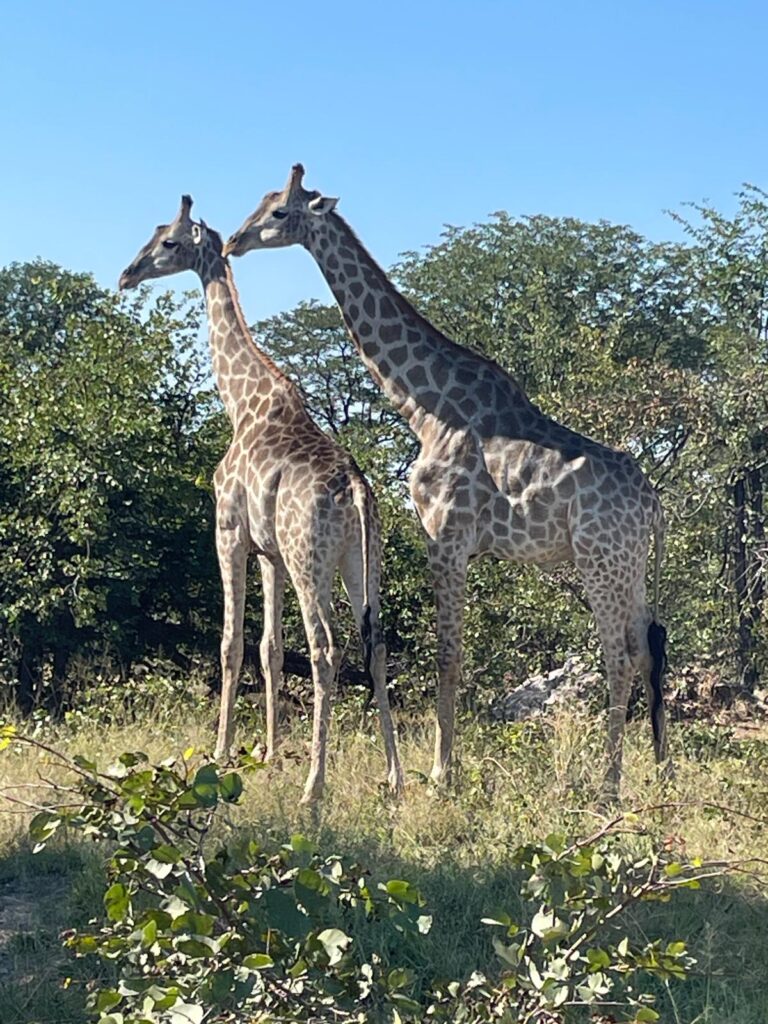
I then did a 12-hour safari game drive through Moremi National Park with them, seeing zebras, wildebeest, elephants, giraffes, cheetahs (a rare sighting), and even a pair of lions just metres from a freshly-killed elephant which surely fed them for several days afterwards.
Golentle is inside a locked compound, which made it feel pretty secure. To be honest though, Maun is one of the safer parts of Africa, and never felt dangerous to me. The only downside I’d say is the fact you’re in a dusty village here 30 minutes away (walking distance) from any real shops or restaurants.
The Trans-Kalahari Border (Namibia Side): East Gate Rest Camp
When it became apparent that I wouldn’t reach Windhoek in a day, the East Gate Rest Camp proved to be my oasis in the middle of nowhere, providing everything needed for a night to break up the long journey.
I stayed in their cheapest non-camping room available, which was a small hut for £13.80. I won’t pretend it was like the Hilton. The mosquito net was much-needed, the light only turns on at 9pm, and when the sun sets it’s FREEZING. Plus I had to brave the cold desert night to reach the separate bathroom.

They do have a small convenience store though, I think they offer breakfast for an extra fee (I didn’t take them up on this though), and most crucially of all, they were able to arrange a taxi to Gobabis for me for N$140 (£6.50/US$8). A shared taxi, but that’s what you’re gonna get here.
It was a slightly uncomfortable experience, although you can upgrade your room for a bit more cash. I highly recommend this place however for the sheer convenience. The small shop, taxi arrangement, and having a reliable spot to get your head down overnight are key perks here.
Windhoek, Namibia: Chameleon Backpackers
When I finally arrived in the capital, I stayed in Morro de Moco for 2 nights. Not a great place if I’m honest, so I decided to spend a couple more nights elsewhere in the capital. Long story short, I ended up at Chameleon Backpackers hostel for around 3 weeks in total. Great place.
I’ll start with the good stuff. Professional staff, security (a must in Windhoek), a bar, a pool, and a decent buffet breakfast consisting of cereals, bread/toast, ham, cheese, and one “other” thing, often muffins. They also had juice available. The £23 (US$31) dorm beds were also comfy, semi-private, and lockers were large.
And the bad? Tours are crazyyyy expensive. I’m talking £550 for a 3-day Sossusvlei tour. I did a budget DIY Sossusvlei trip for £181 which took a little effort, but helped fund my next couple of weeks in Namibia. Two dorm rooms (10 beds total) have a single toilet and two gender-segregated showers between them (but I never had issues here fortunately). And it can get cold on winter nights.
Overall though, this was an oasis of tranquillity from which I was able to get a decent amount of work done, plan the aforementioned Sossusvlei trip, and work out how to reach Swakopmund ahead of visiting the Himba Tribe up north.
My Final Tips For Getting From Maun to Windhoek Smoothly
It’s a looong ride, certainly not a comfortable one. and with safety issues when the sun goes down, this is a journey you want to plan adequately.
My first tip would be to leave early. Get that 5:30am bus, even if you’re like me and absolutely not built for early starts. If you don’t, there’s zero chance of getting to Windhoek in a day. Even if you plan to make this a 2-day journey, I’d advise starting as soon as possible to avoid unexpected problems.
Next up, I advise bringing lots of cash. None of the buses/taxis you use take card. I suggest taking at least 1,100 pula with you. This will cover the 334 pula that I spent in Botswana getting to the border, a little extra to allow for increased prices/hidden surprises, and enough to convert to Namibian dollars to get all the way to Windhoek.

I also suggest you stay at East Gate Rest Camp. Won’t pretend I loved the place, but as I’ve said, it has everything you need for a super convenient break point in the journey, and to make it easy to reach Windhoek in daylight.
And those are the main things really. It’s not a fun trip, you won’t always have internet, but it’s a necessary evil if you’re travelling from Botswana to Namibia overland, and looking to avoid a costly flight.
If you have any questions, please let me know in the comments! Or message me on Insta, I can generally respond within a day or two on there.
