
The Complete Guide To Watching Buzkashi In Afghanistan

Disclaimer: Some links on this page may be affiliate links. If you purchase anything through them, I will receive a small commission at no extra cost to you! Further details in the Privacy Policy.
One of my most memorable all-time travel experiences came when I attended a game of buzkashi in Afghanistan’s northern city of Mazar-i-Sharif.
Buzkashi is an absolutely brutal sport in which riders on horseback compete for possession of a sack, which they’ll eventually drop into a goal circle, before being rewarded financially if they do this successfully. I’ll explain in more detail in the next section.
It was a truly authentic experience which really made Afghanistan feel unique. After travelling to so many countries, I find many places blend into each other and feel like the same thing. In Afghanistan, that wasn’t the case at all, there’s no country on earth that feels similar.
The purpose of this guide is to help you understand exactly what to expect when attending a buzkashi game in Afghanistan. I’ll cover where it takes place, when you can see it, how safe it is to attend, how much it costs, whether women can attend, other rules you should know, and will wrap up by describing my own personal experiences.
This is a must-not-miss experience, so let’s get stuck right into everything you should know before going.

What Is Buzkashi?
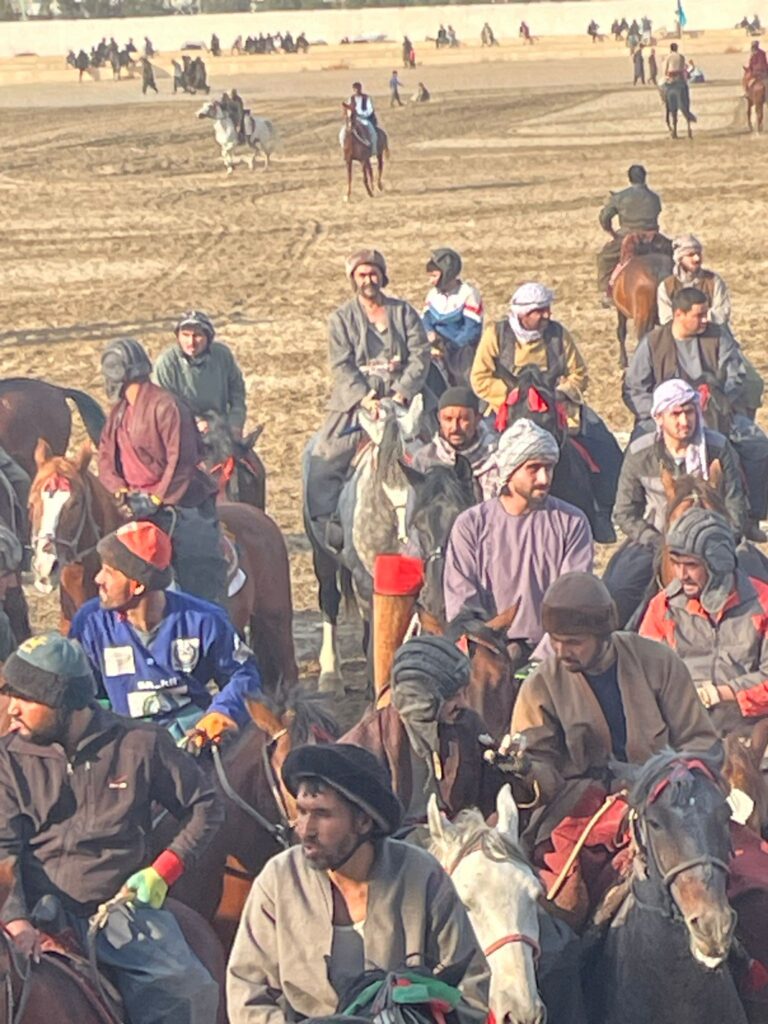
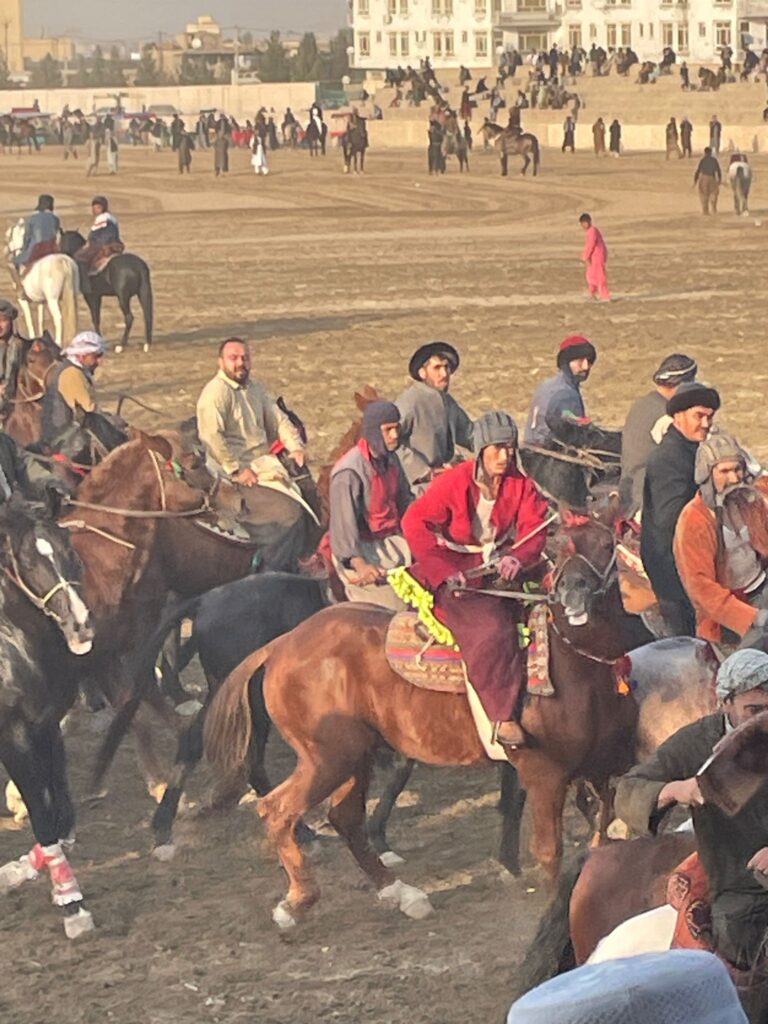
The word “buzkashi” means “goat pulling” in Persian, and the idea is for players on horseback (known as “chapandazan”) to grab a 50kg sack, run around a flag on the opposite side of the pitch, return to the small white goal circle (called the “circle of justice”), and drop the sack into it.
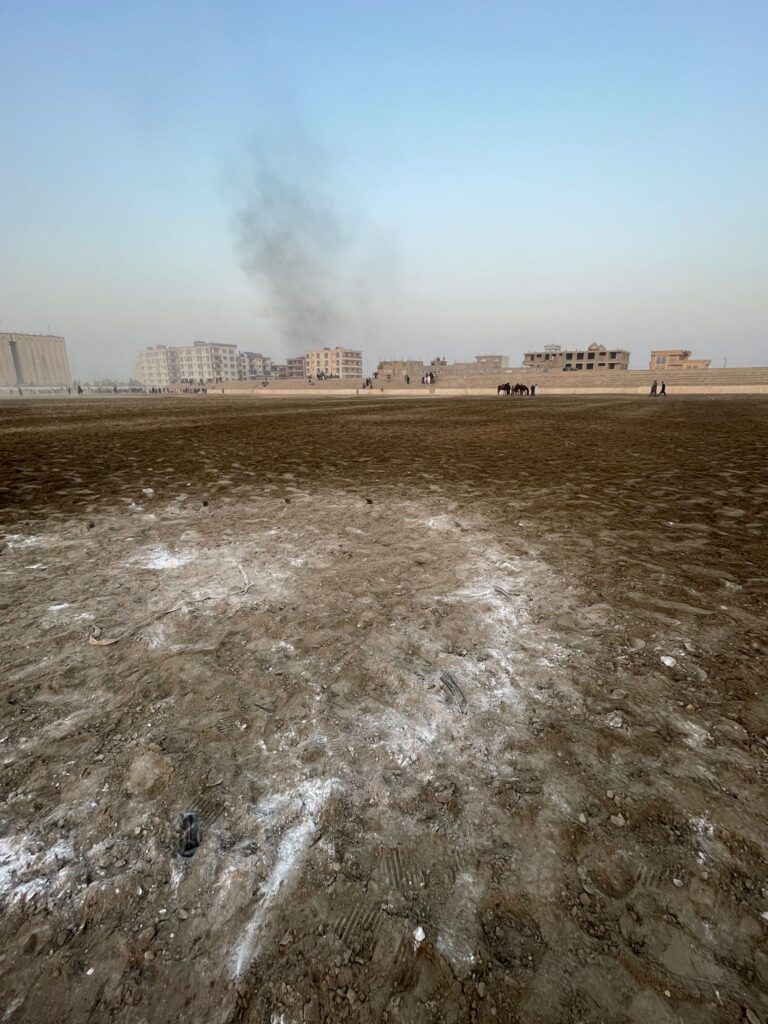
The circle is made from chalk powder, which is replaced regularly as it is quickly scuffed up by the horses.
If you’re wondering why this sport is called “goat pulling”, it’s because until very recently, the carcass of a goat (or sheep, or calf) was used as the “ball” rather than a sack.
In fact, the Taliban banned this sport during their first spell ruling Afghanistan from 1996-2001 because they deemed it immoral, for a number of reasons, but one was because of this use of animals for sport.
Who would’ve thought that the Taliban would turn out to be modern Afghanistan’s animal rights activists, eh?
Other chapandazan will attempt to take the sack from the player in possession, whilst ferociously whipping their horses (okay, the Taliban’s animal rights department still has work to do), and this sport is incredibly dangerous with injuries common, often from players falling off their horses, with deaths not unheard of.
Whenever a chapandaz (chapandazan is the plural term, chapandaz is singular) scores, they will win prize money. They ride over to the VIP box, which is where I was invited to sit as a foreigner. And the prize money is significant. Players were gifted a bundle of afghanis and a US$100 note for each goal they scored. That’s around 2 weeks wages to the average Afghan.
Prizes were much larger before the Taliban regained power in 2021. They are often donated by wealthy individuals, with anti-Taliban warlord Abdul Rashid Dostum famous for giving out large prizes. He’s now in exile, and prizes generally don’t hit the 4-figure sums they could in Dostum’s heyday.
Variations of buzkashi are played all across Central Asia and Western China. Some are even played by riders on yaks rather than horses. But what I described above is the Afghan version I witnessed first-hand in Mazar-i-Sharif.
Compared to western sports, buzkashi is most similar to polo. Albeit far more brutal and less polished.
Rules of buzkashi in Afghanistan:
- Players who gain possession of the sack must do a lap of the pitch, riding around a flag on the other side of the field before they are able to score by dropping it in the circle of justice
- Chapandazan may hit their horses and opposition horses with whips, but cannot hit other players, or attempt to force them off their horses
- The sack can only be held, not attached to any part of the horse or rider
- The game ends when the prize money runs out (which varies from game to game)
When Is The Buzkashi Season In Afghanistan?
Buzkashi in Afghanistan takes place from November-March every year. Games take place on Fridays, starting at 2pm.
With this being Afghanistan, there are always slight variations in the timings. When I went to a game, I arrived around 1pm, although they wouldn’t let spectators into the ground until 1:30pm. Even then, the game didn’t actually start until 2:53pm, so don’t rely too heavily on the “official” start time of 2pm.
I just wish I’d known this before visiting Afghanistan. And in true Afghanistan style, the start and end dates of the season are also pretty vague. I’d advise coming in late November or early March (or between) to avoid disappointment.
Where Can You See Buzkashi In Afghanistan?
There are four locations where you can attend a buzkashi match. Just make sure you have the right permits needed to visit the province you plan to watch a game in.
All locations are in northern Afghanistan, and you can NOT find games in Kabul.
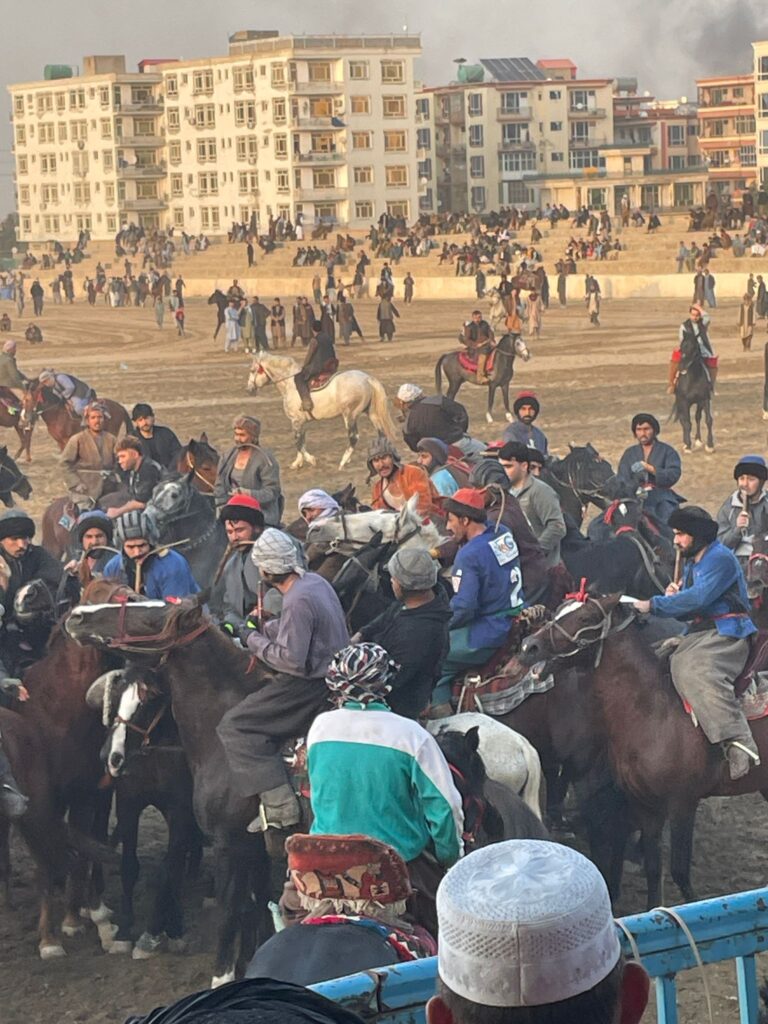
Mazar-i-Sharif is known as the capital of buzkashi. It’s the easiest place to attend it, and where I saw my first game. You can easily take a taxi from the centre for 150 afghanis (£2/US$3).
Buzkashi also takes place in Badakhshan, Kunduz and Sar-e Pol. Here are where the grounds are located on Google Maps:
- Mazar-i-Sharif: Buzkashi ground
- Badakhshan: Buzkashi Field Tajikan
- Kunduz: وزلوبې ميدان/میدان بزکشی (Bezkashi Meydan)
- Sar-e Pol: Unknown location
I’ll be honest with you guys, I couldn’t locate the Sar-e Pol buzkashi ground, and my Afghan contacts didn’t know either. My goal with this blog is to fill it with accurate information rather than going full ChatGPT and making something up.
If you know where to watch buzkashi in Sar-e Pol and can verify your claims, please let me know in the comments at the bottom.

How Much Does It Cost To Watch A Buzkashi Game?
It cost me 40 afghanis (£0.45/US$0.60 at the time of writing) to enter the buzkashi ground in Mazar. You can expect to pay around this figure at any game you go to across the country, but even in Mazar there could be price fluctuations.
In Afghanistan, things are often fluid, and you may end up being charged slightly more or less than I was.
To get to the VIP box, it did not cost any extra. Although again, circumstances may change on the day you attend. I met a local who took me over and asked if I could sit there, and they let me through without asking for more money.

Can Women Attend Buzkashi Games?
Legally, women can go to buzkashi matches, despite bans in the past. Culturally, it is frowned upon, and you won’t see any women there.
There were several hundred people in the ground in Mazar when I went, not a single one of them was female.
I’d advise caution for female travellers going to buzkashi. You would be best off going with a local who knows the language and can defuse any situations, just in case someone does become upset by your presence.
In much of Afghanistan, the rules are bent for foreign women at times to allow them access to places where local women can’t go. For example, I know of many women visiting Band-e-Amir National Park, despite officially being “banned” from going there.
But it’s important to know that “rules” aren’t enforced consistently out here, and could change depending on which characters you encounter on the day.
Do You Need A Guide To Go To A Buzkashi Game?
Technically, you need a guide everywhere in Afghanistan now. In practice, it isn’t enforced, and that’s certainly the case at buzkashi.
I’m a pretty obvious foreigner as a 6’3″ white guy wearing western clothing. I never had any issues with the ticket sellers, the Taliban, or various venue staff despite going without a guide.
A guide could be beneficial to explain how everything works, and help connect you with locals, but they aren’t necessary.
After the game, several street children approached me and other foreigners I met there. They had a guide who helped flag down a taxi for me since their vehicle was full. The traffic was chaotic with everyone leaving at the same time (well to be fair, it’s always pretty bad in this country), but you can visit independently if you keep your wits about you.
How Safe Is Attending Buzkashi In Afghanistan?
Afghanistan no longer has major terrorism issues, but there are two dangers to be aware of at buzkashi matches.
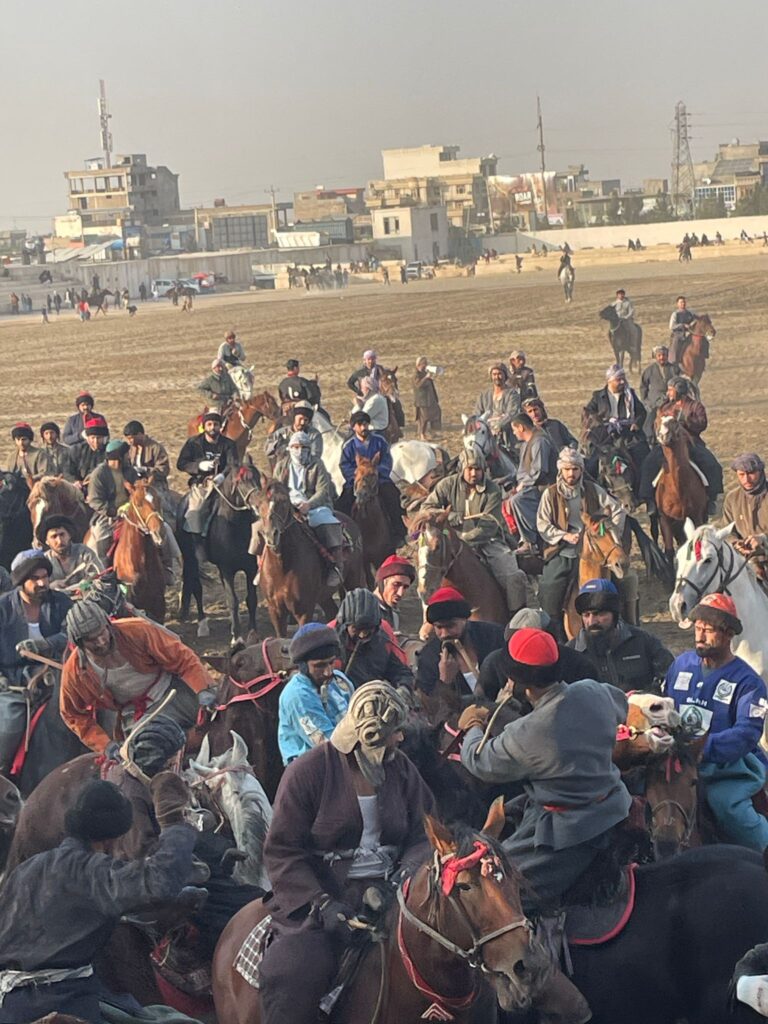
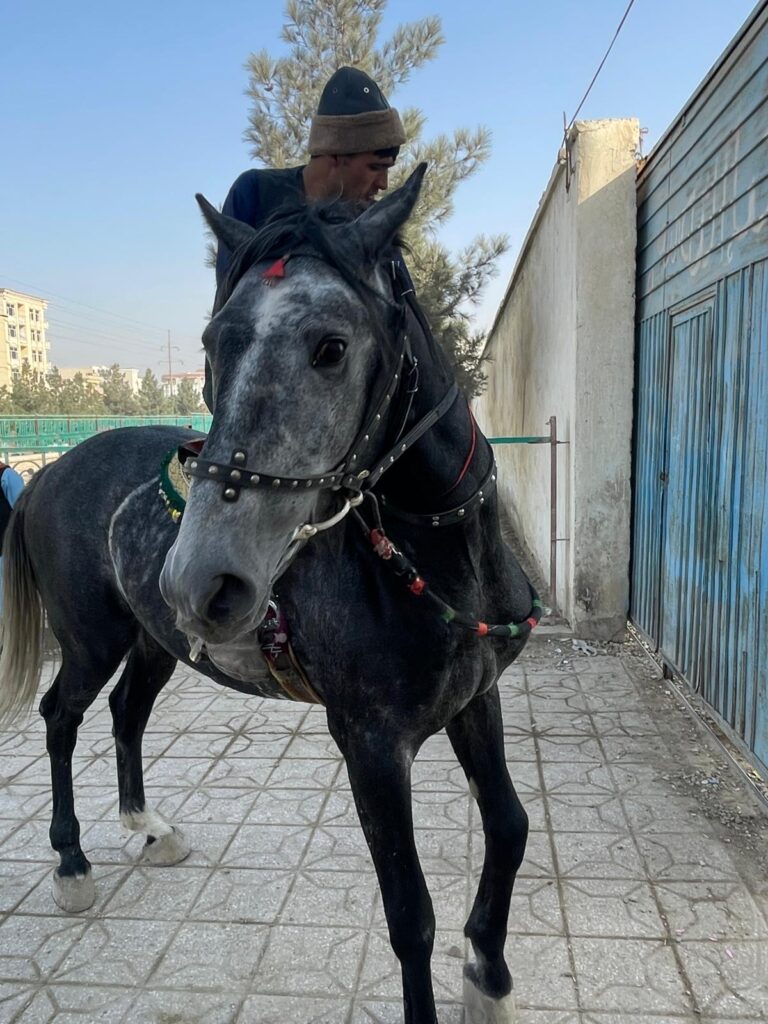
One is the horses. Many of these are bred specifically for sport, and they’re pretty fearsome. Even the riders struggled to control them at times.
The horses would often make erratic movements, both outside the ground as I watched the players arrive, and on the pitch itself.
I was warned by locals to stand further back, as the horses can be dangerous if you get too close.
If you aren’t in the VIP box (which in Mazar at least, is raised above the ground and fenced off), then you will end up sitting on large steps, where the horses can get right up to you. Just avoid sitting in the front row to be on the safe side.
The other danger is street children. Dirt-poor kids who live on the streets, beg for money, and can become quite aggressive.
In the markets of Mazar, I had some attempt to grab me as mobs gathered and tried reaching for my pockets. Both before and after the game here, I attracted far too much interest and the kids swarmed myself and other foreigners I met.
Just keep your distance from children, and make sure your belongings are protected to fully enjoy one of Mazar’s best activities.
What Are The Photography Rules At Games?
You can take pictures of the game or ground with no issues. The only photography rules here, are those which apply across Afghanistan in general: no pictures of the Taliban (without permission) or women.
As I said earlier, you won’t see women here anyway, so in practice that isn’t something you need to worry about.
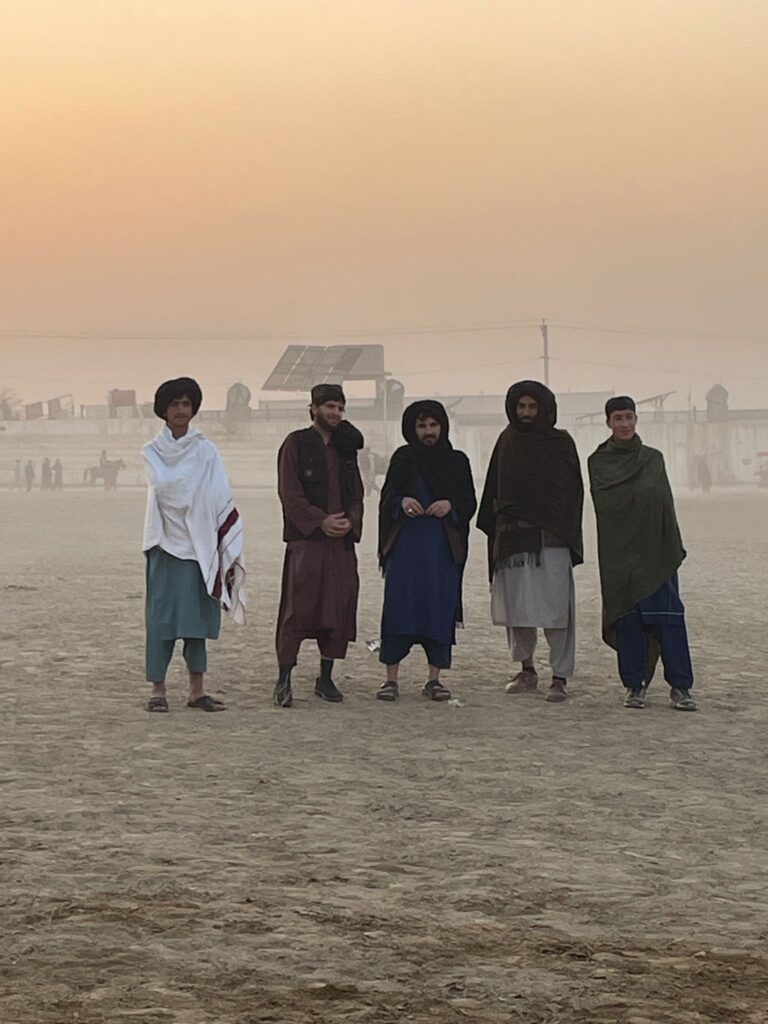
Don’t feel like you need to hold back here. Afghans love being photographed (and will often ask you to take their pictures). Snap away and make sure you get some good pictures for Insta, or wherever you plan to put them.
My Experiences Of Watching Buzkashi in Afghanistan
Annoyingly, I missed the game in Mazar on the day I arrived, after delays leaving Dushanbe the previous day meant I couldn’t apply for my visa in Termez until 9am on Friday morning, and by the time I received it in the afternoon, the buzkashi was already over.
Fortunately it wasn’t hard to get to Afghanistan from Uzbekistan, but these issues meant I had to wait a week before returning to Mazar in order to catch a game.
When the following Friday came, I asked the brilliant staff at Rahat Hotel (where I stayed) how much a taxi to the buzkashi ground would cost me. And they said 150 afghanis (£2/US$3). So sure enough, I took a taxi to the ground from there, it took around 11 minutes, and your journey will probably take a similar time from anywhere in the centre.
Outside the ground, I arrived too early. It was 1pm, an hour before the game was expected to start. I had to wait until 1:30pm until they would even sell tickets (at a bargain 40 afghanis each) to let spectators in the ground.
Whilst waiting, I stood by the entrance and watched as players arrived on horseback. After falling off a horse in Kyrgyzstan, I know what an unstable horse looks like. And sure enough, many of these were erratic and behaved unpredictably, with riders struggling to lead them directly through the gate.
Locals told me to stand back as it was dangerous. And sure enough, this is big business out here, with buzkashi horses bred specifically to play this ferocious sport, so they’re pretty fearsome given their large sizes and aggressive behaviour.
Meanwhile, several street children were gathered outside, wearing filthy torn rags for clothing. Life is bleak for many of these kids who lost their parents during years of war, and now live on the streets forming “gangs” with other orphans.
As the strange white guy in western clothing, I inevitably attracted attention, and many of the street kids tried to surround me. I had to continuously change positions to avoid the risk of being pickpocketed by them. This is a problem with street kids in Afghanistan, and some can be aggressive, so it’s important to remain vigilant at all times.
Eventually, the clock hit 1:30pm and a nice man took my 40 afghanis, before making his way to the front of the mob surrounding the ticket seller, in order to get me a ticket.
As I entered the ground, I met a young English-speaking Afghan in his early 20s. He was telling me how bleak life is in his country, and how he dreams of going abroad to teach English.
This is the problem with countries like Afghanistan. The smartest people dream of moving abroad, which leaves the country unable to retain talent, and as a result it will stay poor, with little opportunity to become a developed nation in the future.
The Taliban have done well to tackle the country’s biggest problem, safety, yet so many other issues remain in a place known only as a nation of instability and conflict amongst almost everyone outside the travel world.
This man took me over to the VIP box, where Taliban officials, the sponsors who pay the prize money, and other key figures were sat.
The box is raised around 2-3 metres above the ground with barriers preventing anyone from falling onto the pitch. A contrast from the rest of the arena which is surrounded by large steps for people to sit/stand on, areas that can easily be reached by the feisty horses.
He spoke with officials, and they let me sit in the VIP box. I sat in the front row initially, but one man took exception to this, throwing a stone at me from the pitch to make me move… I’m sure there were better ways to ask, but hey, welcome to Afghanistan I guess.
Anyway, I sat in the second row, and the game kicked off at 2:53pm, almost an hour after it was supposed to.
Buzkashi is seriously brutal. The players went full throttle, leading their horses into battle in an all-out melee as they attempted to grab the sack. A handful of players lingered around the outside, realising they had no chance of breaking into the crowd where chapandazan continuously whipped their horses, and those of other riders, in an attempt to grab the prize.
Eventually, a player took control of the sack, and charged down the far end of the pitch, where he did a loop around a flag placed in the ground.
A handful of players gave chase, until eventually he ended up back where all the action is, and attempted to place the sack in the so-called “circle of justice” to win a portion of the prize money, as others make a last-gasp attempt to dispossess him of the sack.
His attempt was successful, and the victorious player then came over to where I was sat, before the officials beside me thrust several afghanis into his hand, as well as a US$100 note.
Then everything I just described would be repeated several times over until a pause for a break at 3:45pm. Suddenly, most of the men around me stood up, and went to the back of the VIP box, where they would position mats towards Mecca, and kneel down in prayer.
After around 10-15 minutes, prayer time was over and the game resumed. Under an hour later, at 4:30pm, the last of the prize money was handed out, and the announcer declared that the game was over on the tannoy.
The ground emptied out in no time after that.
I’m used to watching Premier League football (well, not so much in recent years, cheers Saints…) where you’re stuck for several minutes at the end, as supporters wait to exit. That wasn’t the case here, as the attendance of a few hundred (all male of course) piled outside within minutes.
The first and only time I witnessed such efficiency in Afghanistan.
Just as I was about to leave, I noticed another white guy. Whilst this was unusual enough, it just happened to be someone who I met in Tajikistan a couple of weeks earlier. He was there with his friend, who I’d also met, and it took me back to conversations we’d had about visiting Afghanistan. At the time, I had no idea they would be in the country, let alone at the game.
They’d met a third white guy, a photographer who was with his guide looking to take some top quality pictures of the game. We all met together on the pitch whilst leaving the ground (it’s not like the Premier League, you just walk across the pitch here), and headed to the exits together.
At this point, we drew a lot of attention from street kids, who were constantly trying to grab the first guy I’d met in Tajikistan. We had to carefully shake them off, and eventually made it out the ground.
At this point, their vehicle was full, but their guide helped wave down a taxi to take me back to central Mazar-i-Sharif.
We agreed on a price of 100 afghanis, and he tried to rip me off by demanding 200 when we arrived at what I thought was my destination. It was lucky I resisted and didn’t give into his scam, as he dropped me a 10-minute walk from where I actually wanted to go.
Not great, considering the sun was now setting and I didn’t fancy walking around a part of Afghanistan I don’t know alone after dark.
Fortunately, things worked out eventually, and I made it back to my hotel at the end of the day with nothing but great memories.
Afghanistan was my 89th country, so I was reasonably well-travelled by this point, and yet it threw up something new and incredibly interesting in the form of the buzkashi. A genuine all-time top travel experience that will live with me for years to come.
As a result, I’d recommend coming to Afghanistan in November, just as I did. It’s cold in places, and the Wakhan Corridor is off-limits due to the weather, but watching buzkashi capped off a magical experience in what was by this point, one of my top 10 countries in the world.
More Posts on Afghanistan
- The Best Things To Do In Balkh During Your Afghanistan Trip
- The Complete Guide To Watching Buzkashi In Afghanistan
- What I Wish I Knew Before Travelling To Afghanistan
- What Are The Best Things To Do In Mazar-i-Sharif?
- How To Cross The Hairatan Border From Termez To Mazar-i-Sharif
- How To Get An Afghanistan Visa In Termez (Uzbekistan)
- The Complete Afghanistan Travel Guide
